Silicon
Si
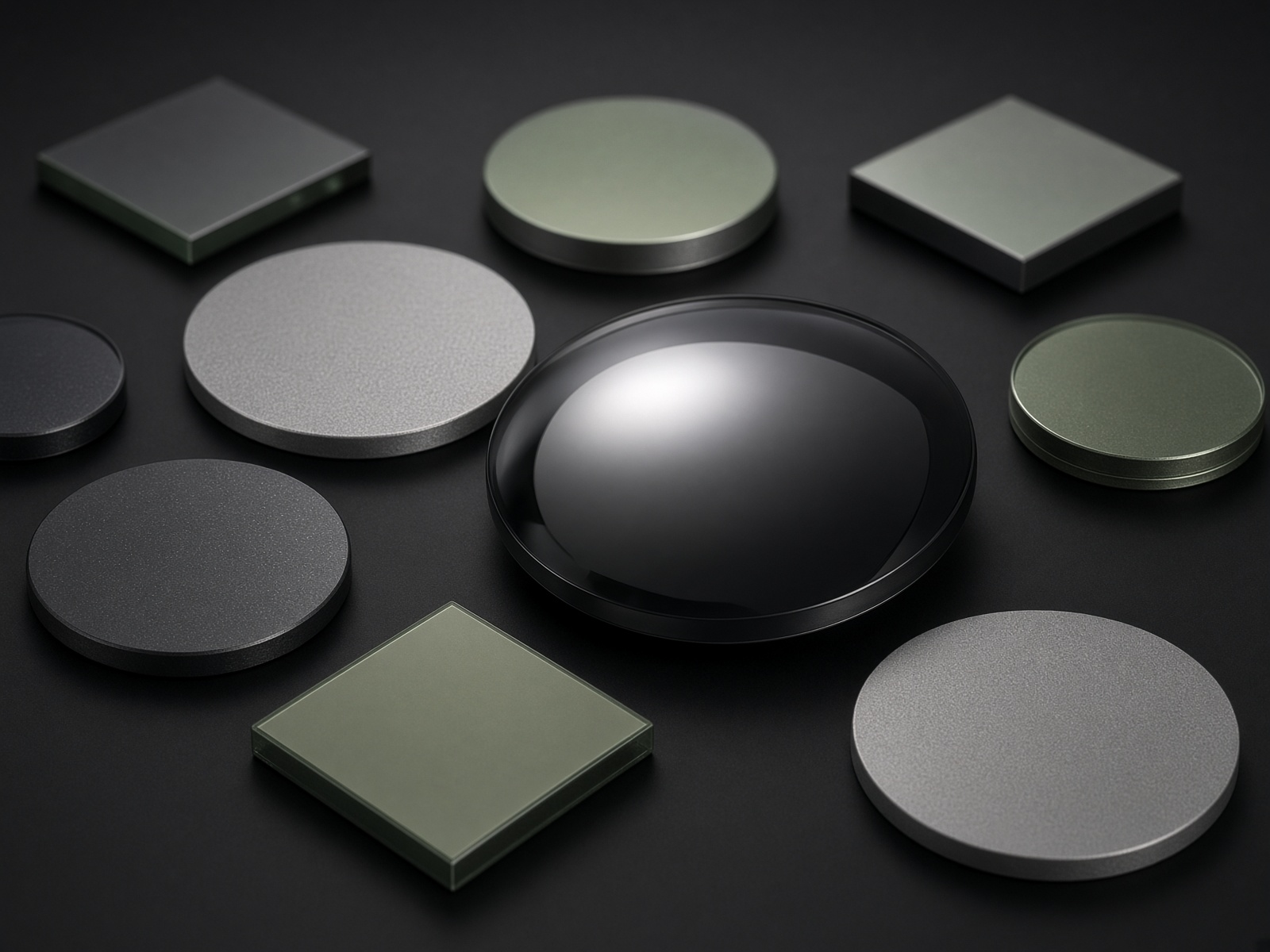
Infrared-grade monocrystalline silicon for MWIR imaging, spectrometers and laser optics — lightweight, stiff and cost-effective.
Used in
MWIR cameras, spectrometers, laser optics and environmental monitoring instruments between 1.2 and 7 µm.
- IR-grade monocrystalline: PV 0.084 λ, RMS λ/111
- Low mass for airborne and automotive payloads
- HR and AR coatings for 1 µm lasers through MWIR
Capability
| Diameter | φ3 – 300 mm | |
|---|---|---|
| Scratch / Dig | 40 / 20 | 1300 Lux |
| PV | λ/8 @ 632.8 nm | Zygo |
| Irregularity | 0.1 λ @ 632.8 nm | Zygo |
| RMS | λ/50 @ 632.8 nm | Zygo |
| Parallelism / decentration | 10″ / 30″ |
Forms & coatings
Forms
- Windows (round / rectangular)
- Lenses (plano-convex, biconvex, meniscus)
- Prisms, wedges, aspheres
- Special-shaped components
Coatings
- AR 2–4.5 µm
- AR 3–5 µm
- R > 99% @ 1064 nm
- R > 98% @ 2–12 µm
- AR 0.3–5 µm
- AR + DLC 3–5 µm
- AR + DLC 8–14 µm
Curves are measured on 1–2 mm plane-parallel witness coupons.
Questions buyers ask
- Is silicon transparent in the LWIR?
- No. Infrared-grade silicon transmits from about 1.2 to 7 µm (SWIR–MWIR). For 8–12 µm thermal cameras use ZnSe, ZnS or chalcogenide glass instead.
- Why specify silicon for MWIR lenses?
- High index, low density and good stiffness make silicon a light, cost-effective MWIR substrate for airborne, automotive and spectrometer payloads.
- Can you coat silicon for 1064 nm and MWIR on the same part?
- We run HR (R > 99% @ 1064 nm), broadband AR 2–4.5 / 3–5 µm and AR + DLC 3–5 µm. Send both wavelength bands on the drawing.
Transmission windows
One factory, 0.4 to 21 µm
Pick a material by infrared band. Typical design windows overlay a log-scale spectrum from NIR through LWIR.
NIRSWIRMWIRLWIRFIR
0.4 µm2.558–1221 µm
- ZnSe0.6 – 21 µm
- ZnS0.4 – 12 µm
- Si1.2 – 7 µm
- ChG1 – 14 µm
Other substrates